

What's up my people!! This was a question I got the other day from a patient and it made me think for a second on how exactly to answer it. So, decided to put this in writing for you all so I could elaborate a bit more.
Here is the question: If your shoulder hurts when you sleep on your side, the easy answer is that you're just sleeping wrong. Sometimes that's part of it. But if you're consistently having pain when you lie down at night, throughout the night, or first thing in the morning, there's a really good chance your sleep position is highlighting a problem that is already there.
A sleep position problem and an underlying shoulder problem are not mutually exclusive. How you sleep can make an irritated shoulder angrier, and it can put a spotlight on something that's been quietly building during the day. And sometimes, the problem you feel in your shoulder isn't coming from the shoulder at all. (What? Andy is saying somethings not as it appears? Shocker!) More on that in a minute.
Why Does My Shoulder Hurt When I Sleep on My Side?
When you lie on your side, the bottom shoulder is pressed into the mattress, and your neck sits in whatever position your pillow puts it in. And also, of course, sometimes you throw your arm into wonky positions. I'll make this one simple- if you are above 90 degrees (elbow is ABOVE shoulder), you significantly increase possible stress. Then, you stay that way for hours. If something in that area is already irritated, a position like that can be enough to wake it up.
So the better question isn't just "what's wrong with how I sleep?" It's "what is my sleep position aggravating?" The answer depends on what's driving your symptoms, so that's what I want to help you figure out.
Is It Actually My Shoulder? A Quick Daytime Check
Before blaming your pillow or your mattress, find out whether your shoulder is just plain irritated. Let's test this during the middle of the day, when you've recovered from whatever sleep position seems to be bugging you. You may have a problem with certain movements that you don't really notice. Proper testing should be done by a skilled physical therapist that knows their sh%t, but here's a simple place to start. Check these three basic motions:
- Flexion: Raise your arm straight out in front of you and up overhead, as far as it will comfortably go.
- External rotation: Keep your elbow locked into your rib cage and move your hand out to the side, like a door swinging open.
- Abduction: Move your arm out to the side and up, the way you would if you were making a snow angel.
If those hurt during the day, then you've probably got some kind of irritation going on in your shoulder. If that same irritation is then getting worse at night, there's a good chance we can optimize your sleep position so the position itself isn't making things worse while the underlying problem gets addressed. In fact, just changing the sleep position could play a massive role in fixing the problem altogether.
One note: this is a check, NOT a diagnosis. Move gently, and if a motion gives you sharp pain, stop there. Don't push through it to prove a point.
Could It Be the Shoulder Capsule?
Probably not, at least not from sleeping. The capsule is the connective tissue that surrounds the shoulder joint. Unless you have adhesive capsulitis (often called frozen shoulder), which is very rare, you're really not going to have any issues with the capsule when you're sleeping.
You only run into the shoulder capsule at end range of motion. End range means you can't push the arm any farther, even if you were to have someone pushing it for you. That's because it's literally out of room. It would feel stiff here, and we call it a "firm end feel." Most people aren't sleeping with their shoulder cranked into that position. So if the pain shows up while you're lying still, the capsule usually isn't the culprit.
Why Is Shoulder Pain Worse at Night? Check Your Neck
Here's where a lot of people get surprised. It could be the rotator cuff, but in most cases there's some kind of nerve issue that's actually referring pain into the shoulder. Referred pain is pain you feel in one spot that's being driven by irritation somewhere else.
And a lot of times, irritation in the nerve that GOES to the shoulder may put a magnifying glass on a small or large tear in the shoulder. Combinations of both problems like this are common as well, and can particularly painful.
This can be hard to believe. You feel the pain in the shoulder very clearly. It hurts when you move your shoulder and when you use your shoulder, not your neck. Hell, you may have even had imaging that CONFIRMED A ROTATOR CUFF TEAR. But even a slight irritation in the neck can put a magnifying glass on anything that's going on in the shoulder. And if the pain is happening in a resting position, when you're not really using the shoulder, there's a good chance the neck is involved.
You may be reading this and thinking, "Well, this doesn't apply to me. I had an MRI, it showed a shoulder problem, all my doctors have been looking at it, and all my pain is right here." Think again.
Sometimes you don't know what you don't know. Even what feels like a 100% shoulder problem (yes, I'm talking to you) can have more involved, even if your neck MRI looks okay or you don't have neck pain. That doesn't mean your shoulder findings don't matter. It means the shoulder may not be the whole story. If you want to read more about how the neck can play into this, take a look at my neck pain page.
Can Side Sleeping Cause a Rotator Cuff Tear?
NOPE. You ever try to tear a steak in half? Kinda hard to do, isn't it. You're not tearing a rotator cuff asleep.
What Is the Best Sleeping Position for Shoulder Pain?
There's no single perfect position for everyone. Preferably, just sleep on your back and lie your hands across your body, or let them stay by your side. If you don't like your shoulders hanging down by your sides, you can place a towel roll or pillow under them so they are slightly elevated.
That said, a lot of people simply can't stop side sleeping. If that's you, here are two adjustments that can help.
Put a Pillow Under Your Rib Cage
Place a pillow under your rib cage so your rib cage gets a little bit elevated. That gives your shoulder a little more room to lie flat on the bed without digging into the mattress so much. You should feel less pressure on the point of the shoulder. If the setup makes your symptoms worse, don't force it. Adjust the pillow height or try something else. 2-3 inches thick should do it.
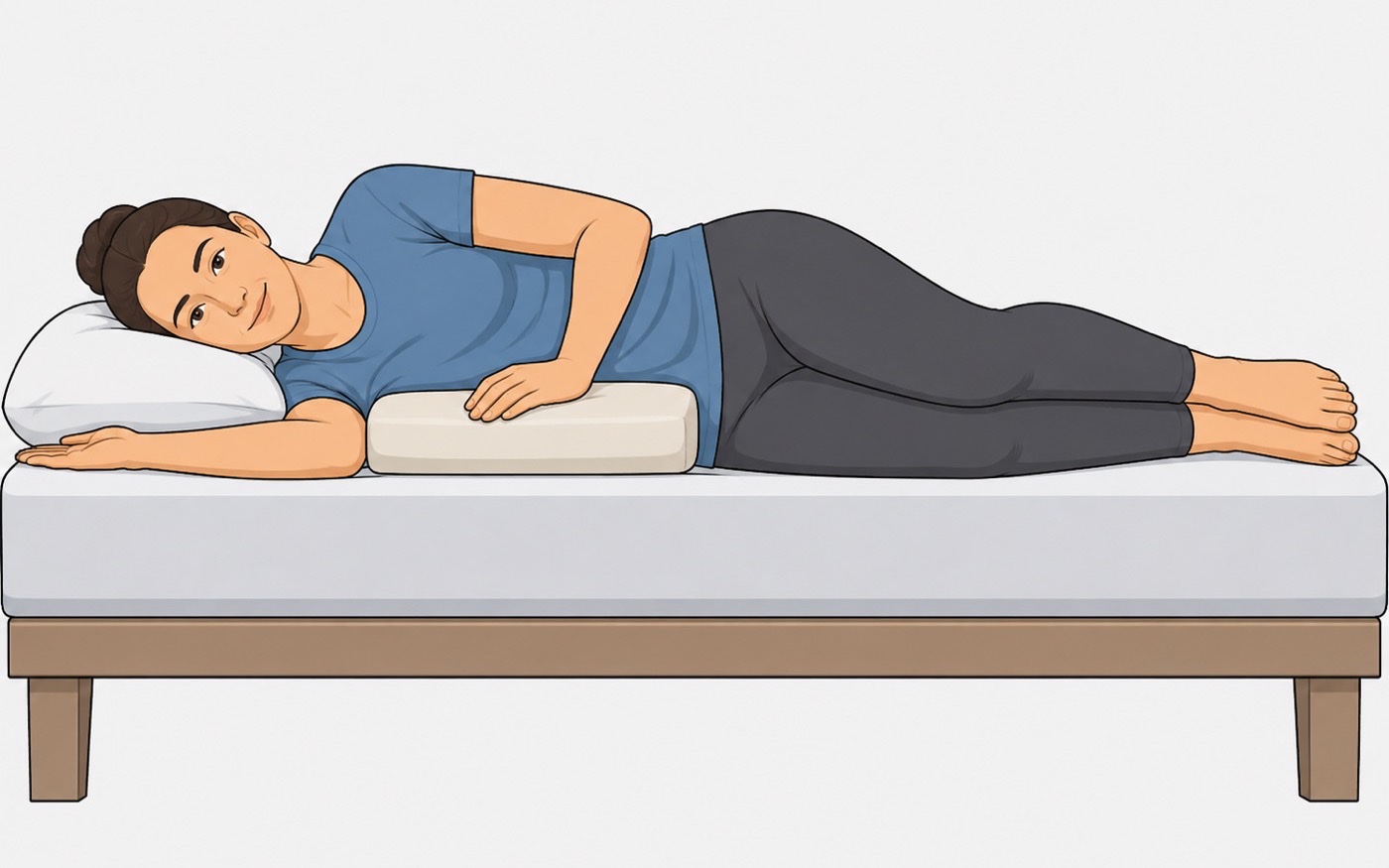
Get Your Head and Neck Closer to Neutral
The other thing you can do is adjust your head and neck position so your neck and spine are better supported and your head sits closer to neutral, rather than tipped up or dropped down toward the mattress. Given how often the neck is involved in night-time shoulder pain, this one matters. I can walk you through at least somewhat how this can work in this video.
These changes are a starting point. They can take some of the pressure off at night, but they don't address whatever is irritated in the first place. If they help, GREAT! If not, it doesn't mean nothing can be done. It just means you need a little bit more evaluation.
When Should You Get Your Shoulder Checked?
If your shoulder pain keeps showing up at night, if the daytime motions above are painful, or if you're noticing numbness, tingling, or weakness into the arm, it's worth getting a proper evaluation. If the pain started after a fall or injury, if you suddenly can't lift your arm, or if shoulder pain comes with symptoms like chest pain, shortness of breath, or fever, see a medical provider promptly. If you find that every night, you are unable to actually fall asleep because you have shoulder pain that is constant, and unchanging with positions, tell your doctor immediately, as this could be more serious.
You can learn more about how I approach this on my shoulder page and in Restoring Shoulder Function: The Role of the Physical Therapist.
I'm a Doctor of Physical Therapy at Trem Therapy Solutions in Delaware, Ohio. I do fully online and in-person treatments. If you'd like help figuring out whether your night-time shoulder pain is coming from the shoulder, the neck, or a bit of both, I am here for you! You can reach out to me here.
I hope this article was helpful! Sleep well my friends!
Dr. Trem